A sustained commitment to inclusive design, carried from doctoral research into everyday studio teaching
Accessibility is often taught as compliance. Students are shown Part M diagrams. They learn the turning circle, the gradient, and the clear width. They pass the assessment. They then design buildings that disabled people cannot comfortably use.
The problem is not a lack of information. It is a lack of understanding. A dimension on a page carries no weight until a person has felt what that dimension does. Regulatory knowledge is necessary, but it is thin. It tells a student what is permitted. It does not tell them what is experienced.
Architecture for Everyone is my response to that gap. It is not a discrete project with a start and an end. It is a commitment that began in doctoral research and now shapes how I design briefs, run studios, and structure site analysis. The principle is consistent throughout. Disabled people are not a user group to be accommodated at the end of a design process. They are participants in it, and their expertise is treated as expertise.
The commitment began with my PhD at the University of Nottingham, funded by Hitachi and delivered in partnership with Motionspot.
The research addressed the platform-train interface. This is the gap between a rail carriage and a station platform. It varies in width and in height across the network. For users of mobility assistive devices, it is one of the most persistent barriers in the built environment.
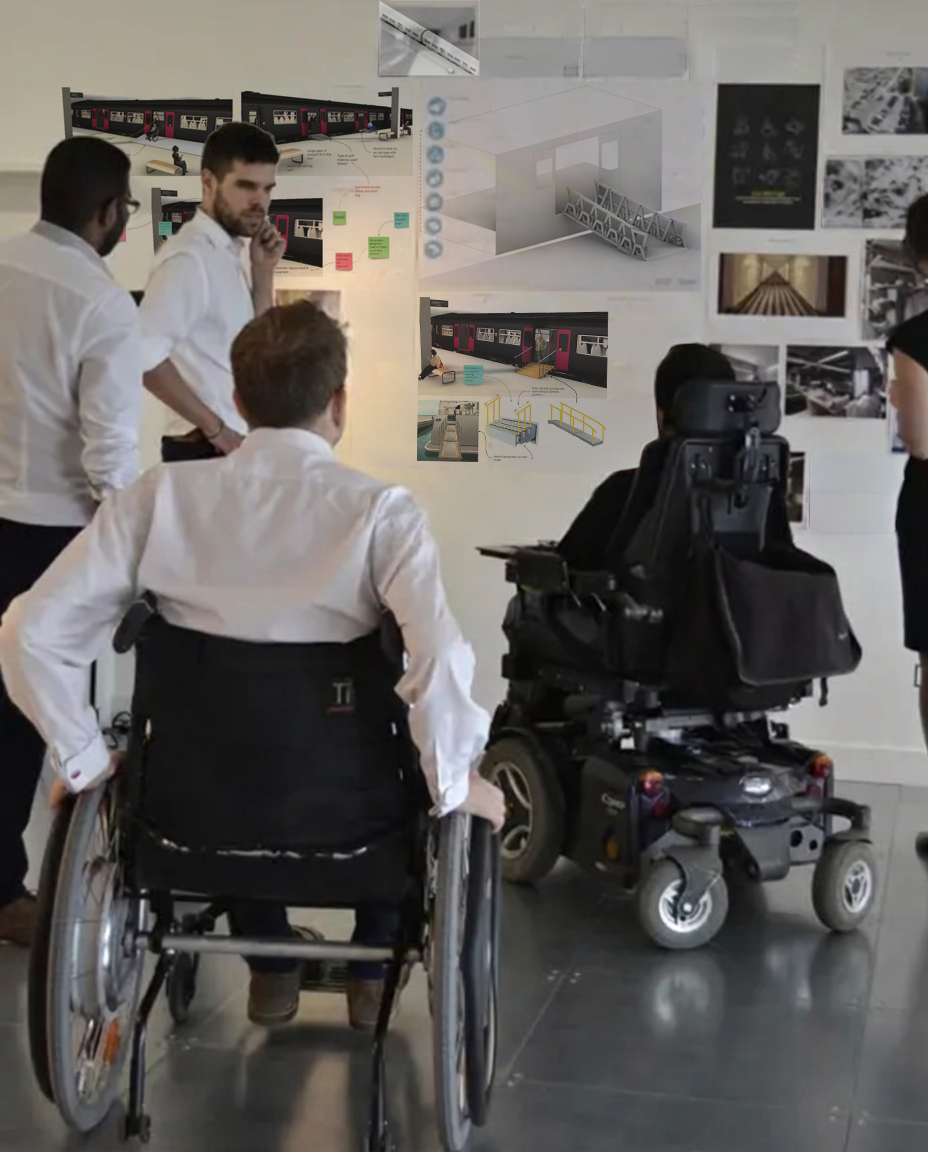
I did not design a solution and then test it on disabled people. I designed it with them. Over fifty disabled participants contributed across the project. Co-design workshops established the qualities the solution had to possess. Those qualities were set by users, not by me (Figure 1).
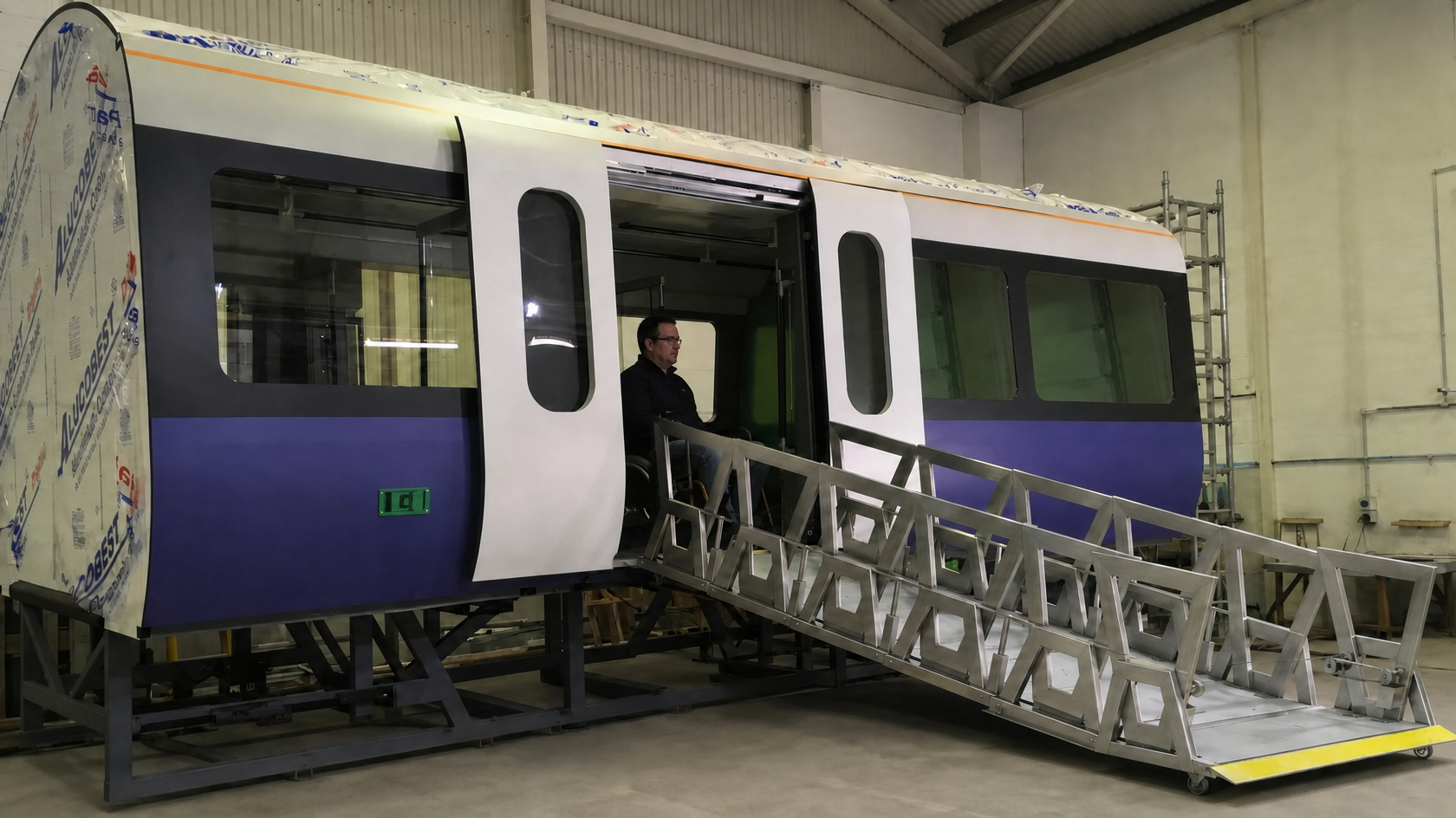
The work culminated in an adaptive access ramp. It comprises six nested segments that unfold through a controlled curling motion. It bridges the full range of gap conditions found across approximately 95% of the UK rail network. I built a working prototype and evaluated it with twenty-five disabled participants in a mock-up train setting (Figure 2). Their feedback identified a refinement I had not anticipated. I implemented it, and the design loop closed.
Two lessons from that work now govern my teaching. The first is that disabled people hold design knowledge that no non-disabled designer can generate alone. The second is that this knowledge transfers only through direct contact and direct experience. It does not survive translation into a diagram.
The commitment is delivered through three complementary strands. Each addresses a different limitation of conventional accessibility teaching.
I regularly invite disabled guests into my studios. They are not there to give an awareness talk. They are embedded in the working process of the module.
Their contribution has three parts. They describe exclusion in the built environment from direct experience. They then work with students during the drafting of proposals. Finally, they return to review those proposals against their own criteria.
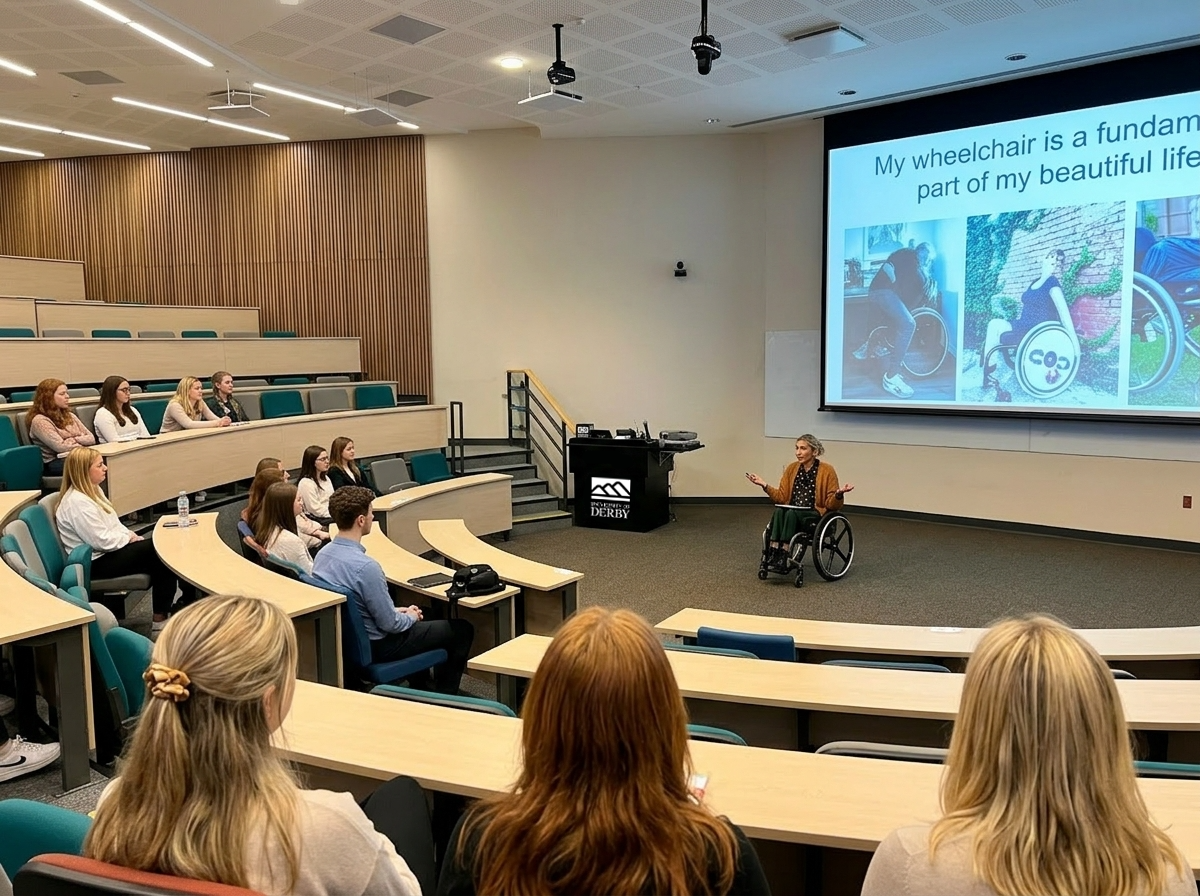
Karrie J., a mobility-disabled architect, is one such contributor (Figure 3). She holds both forms of authority that this work requires. She is a professional peer, and she is an expert in her own exclusion. Students receive her critique as they would receive that of any visiting practitioner. This is a deliberate framing. Disability expertise is positioned as professional expertise, not as a request for sympathy.
This strand is the ethical foundation of the whole initiative. The simulation exercises described below are of value only because students first hear from the people whose lives are actually shaped by the decisions they are learning to make.
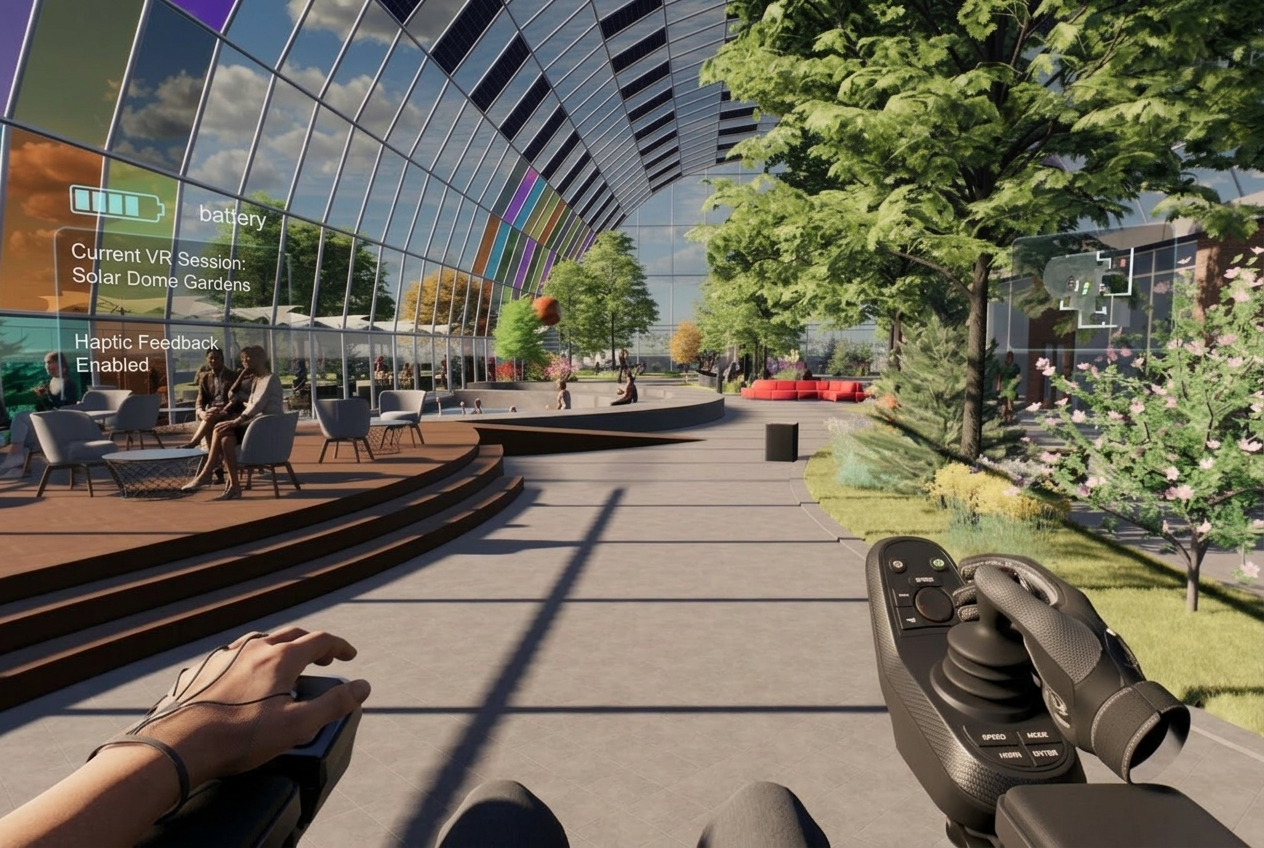
Every studio project I run now carries an embodied brief. Before students draft an initial concept, they must survey the site in virtual reality from three simulated perspectives.
The first is that of a wheelchair user (Figure 6). The second is that of a low-vision user. The third is that of a neurodivergent user. The eye height changes. The route changes. The acoustic and visual load changes. The site is not one site. It is several, and they do not agree with one another.
The pedagogic effect is one of sequence. Accessibility is encountered before the first line is drawn, not after the scheme is resolved. It therefore enters the work as a generator of form rather than as a correction to it.
The third strand is the most demanding, and the most radical.
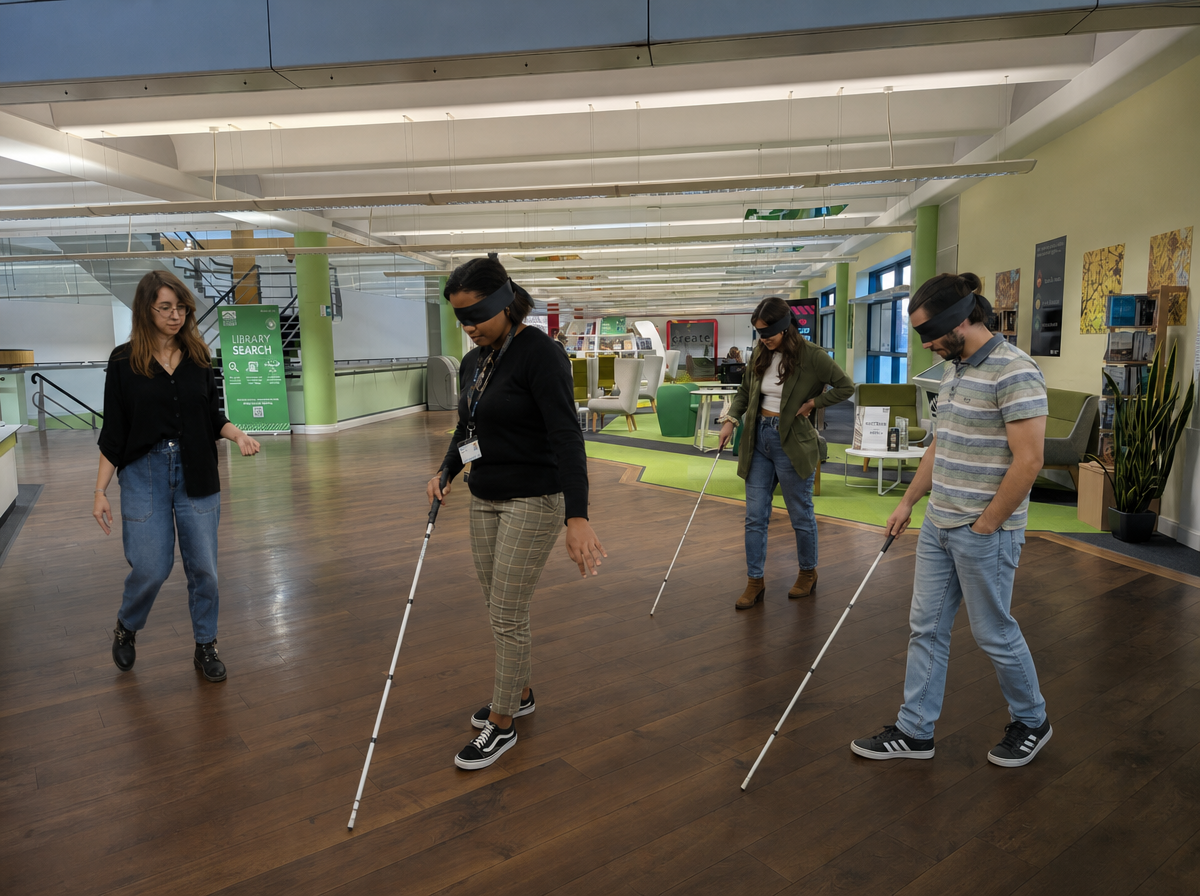
I asked the university workshop to construct a stepped platform. I borrowed five self-propelling wheelchairs and a set of white canes from the British Red Cross. I then set the cohort a challenge that ran across a full studio day.
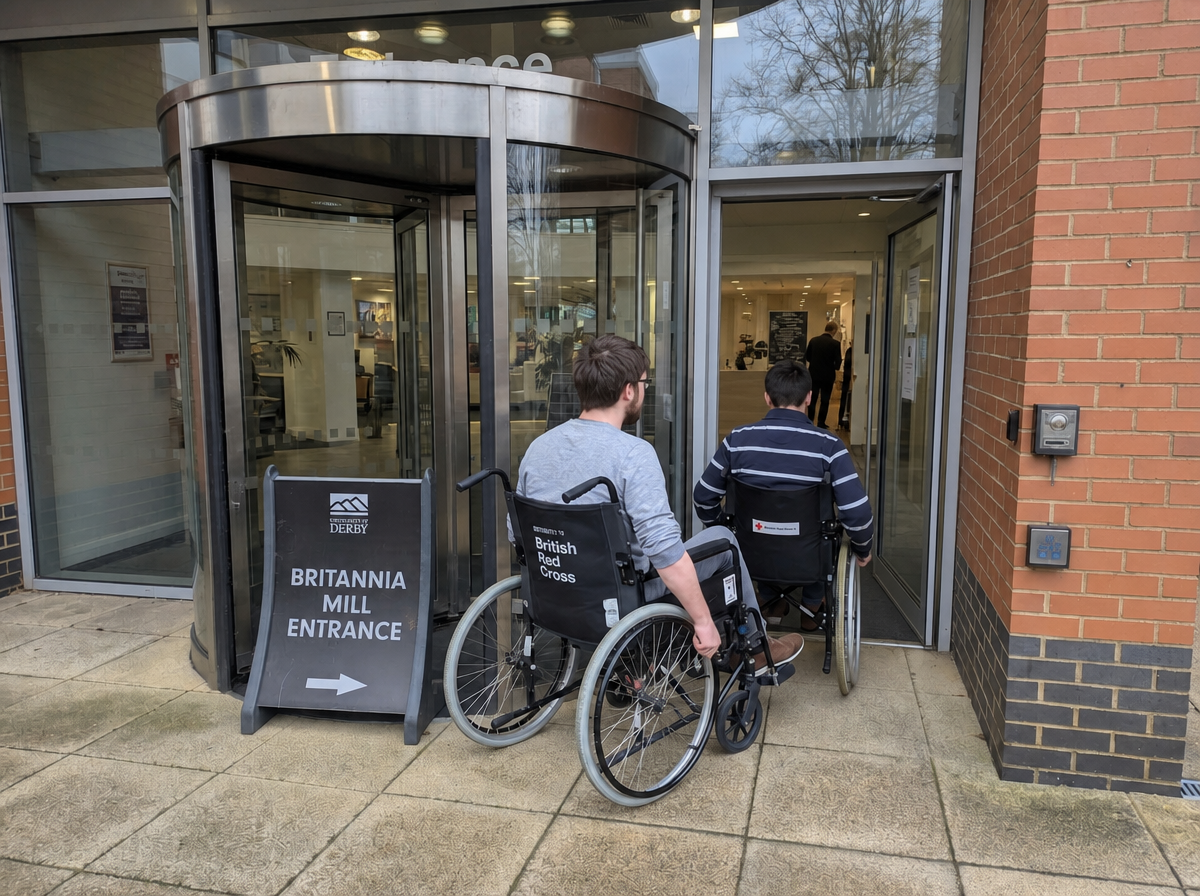
Each student had to complete a sequence of apparently simple tasks, unassisted by their peers. Opening a door. Ascending a ramp. Crossing different surfaces, including grass. Reaching and operating a lift. Using an accessible toilet (Figures 4 and 5).
The prohibition on assistance is the pedagogic instrument. Help converts a barrier into an inconvenience. Without it, students meet the barrier as a barrier. A revolving door stops being a detail and becomes an obstruction. A threshold of a few millimetres becomes a wall. Grass becomes impassable.
What students report afterwards is not information. It is recognition. They understood the regulations before the exercise. They did not understand what the regulations were protecting against.
That understanding proved durable. It did not fade at the end of the day. It embedded itself in how those students subsequently designed. Neither a textbook nor a Part M diagram has ever achieved the same result in my experience.
The reason is familiar to anyone who teaches design. Some knowledge is only available through the body. It is the same reason we still ask students to draw by hand and to build physical models. The hand knows something the screen does not. The same is true here.
The doctoral strand produced four publications, including a journal article now cited over two hundred times, alongside a validated design proposition developed with and for disabled users.
The teaching strand has produced a change in student practice that is visible in the work. Three effects recur.
The strands also reinforce one another. Research furnishes the methods. Teaching tests them with a new cohort each year. Student work then raises questions I take back into research.
This work rests on a single conviction. Inclusive design cannot be taught as a set of dimensions. It has to be taught as a relationship with the people the dimensions exist to serve. Four claims follow.
Research to Pedagogy
It evidences a direct line from research to pedagogy. The participatory methods I developed at doctoral level are not described to students. They are practised by them. The research is not a credential attached to the teaching. It is the source of it.
Experiential Learning
It evidences experiential learning of a demanding kind. The unassisted studio day places students in a condition of genuine difficulty, with the usual social remedies withdrawn. This is uncomfortable by design, and its effect is durable in a way that instruction is not.
Productive Use of Immersive Technology
It evidences the productive use of immersive technology. Virtual reality is deployed here to redistribute perspective, not to render proposals attractively. It gives students access to spatial conditions they cannot otherwise occupy, and it does so at the point in the process where the knowledge is most useful.
Consistent Ethical Position
It evidences a consistent ethical position. Disabled people appear throughout this work as co-designers, as expert critics, and as invited professionals. Simulation is used to build empathy for a barrier. It is never used as a substitute for the authority of those who live with that barrier daily.